What to Grow Indoors in Winter (UK Guide)
Herbs that survive a bright windowsill, microgreens and pea shoots with no kit, what to sow under grow lights, and how to beat damp - a UK winter guide.
Deciding what to grow indoors in winter in the UK starts with one honest number: by late December, most of the country gets less than eight hours of weak, low-angled daylight. Indoors is warm enough for almost anything, but bright enough for surprisingly little - so the winter growers who stay cheerful are the ones who pick crops to match the light they actually have, not the light they wish they had. This guide continues our autumn balcony guide indoors, through the darkest three months.
How much light does a UK winter actually give you?
Around the winter solstice in late December, London sees just under eight hours between sunrise and sunset, and northern cities see closer to seven. The sun also sits low, so even that daylight arrives at a slant, filtered through cloud on most days. A plant on a UK windowsill in December receives a small fraction of what the same sill delivers in June.
Orientation decides what is possible. A south-facing sill is the only spot that supports slow winter growth in herbs and salads; east and west sills will hold plants steady rather than grow them; a north sill in winter is maintenance-only territory, as anyone who has read our north-facing balcony guide will recognise. Two practical rules follow. First, put your most ambitious plants on the brightest sill you have and accept the kitchen spider plant can move. Second, treat everything as growing in slow motion: less water, less feed, fewer harvests - but not none.
Which herbs survive indoors over winter?
Three herbs earn their sill space reliably. Chives keep producing thin but usable leaves on a bright sill all winter, especially if you pot up a clump from outside and let it settle. Flat-leaf parsley is biennial and shrugs off low light better than most - growth is slow, but a decent-sized pot gives you a garnish-grade picking every week or two. Mint looks dead outdoors by November, but a section of root potted up and brought inside will push fresh shoots within a few weeks; it is the closest thing to a winter cheat the herb world offers.
The disappointments are just as predictable. Basil wants warmth and strong light together, and a centrally heated room with a dim window gives it exactly half of that - expect leggy stems and drop-off unless it lives under a light. Rosemary, thyme and sage are hardier outside than they are happy inside: dry radiator air and low light suit them worse than a sheltered balcony corner does, so leave them out and pick sparingly. Supermarket herb pots sit in the middle: they are dozens of seedlings crammed into one pot, so split them into two or three pots, water from the bottom, and treat any that make it to spring as a bonus.
What can you grow on a windowsill with no kit?
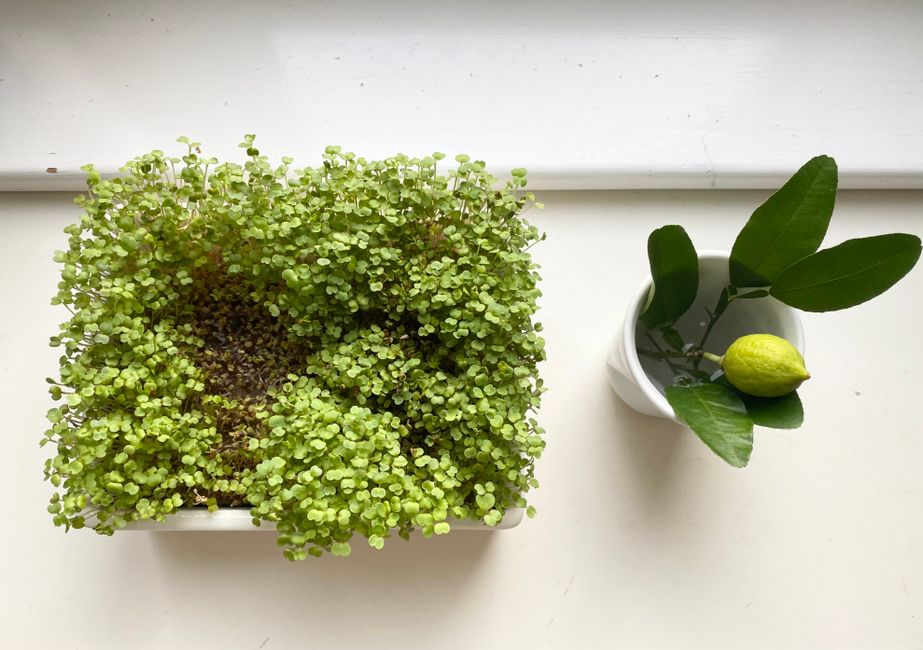
The most productive winter crop in the country needs no equipment at all. Microgreens (seedlings harvested at the first-leaf stage, usually 7 to 14 days after sowing) grow happily in December because they barely need light - the seed itself powers most of the growth. A tray of radish, pea or sunflower shoots on any sill turns over a genuine harvest every fortnight all winter; our microgreens guide covers trays, seed density and the rotation that keeps a supply coming.
Pea shoots deserve their own mention: cheap dried marrowfat peas sown thickly in a seed tray give two cuttings of sweet shoots within three weeks, even on an east sill. Cut-and-come-again salads (harvesting the outer leaves so the plant regrows for several more pickings) work on a south sill only - winter lettuce, lamb's lettuce and mizuna tick over slowly but genuinely. Beyond eating, prepared hyacinths and paperwhite narcissi planted in November flower indoors around midwinter, and spring onion bases regrown in a jar of water on the sill give usable green tops within a week or two. None of it is dramatic. All of it works.
What should you sow under grow lights?
A grow light (a full-spectrum LED made for plants) removes the light ceiling entirely, and winter is when it earns its keep. Leafy crops - lettuce, rocket, pak choi, basil, coriander - grow at close to summer pace under 14 to 16 hours of light a day, whether that is a panel over a shelf of pots or a self-contained hydroponic garden. If you are choosing kit, our grow light spectrum explainer covers what the specs mean, the hydroponic running costs breakdown puts real numbers on the electricity, and the indoor garden and grow light sections hold our research-based reviews of the usual suspects, from the Click & Grow Smart Garden 9 to the iDOO 12-pod.
Pod systems have a natural winter rhythm: sow salads and herbs in the pods from November through January and the machine ignores the season completely. The other job for a light is the late-winter head start. Chillies are the classic - sown in late January or February under a light, they get the long season they need to ripen in a UK summer. Early tomatoes follow from late February. Both move out to the balcony after the last frost, which is the hand-off point where this guide ends and the spring one begins.
How do you beat damp, mould and fungus gnats?
The UK winter problem indoors is rarely cold - it is damp. Plants in eight-hour light use a fraction of the water they drink in June, so the compost stays wet for weeks, and wet compost in a warm room is exactly what surface mould and fungus gnats want. The fix is the same for both: water less than feels right, let the top couple of centimetres dry out fully between waterings, and water from the bottom so the surface stays dry. A furry white compost surface is a signal to stretch the watering interval, scrape off the top layer and improve airflow - not a reason to bin the plant.
Condensation adds its own trap. A sill above a radiator behind a closed curtain swings from tropical by day to a cold, wet pocket at night; leave curtains slightly open behind plants on frosty nights, or pull pots into the room. Crack a window for a few minutes daily in rooms full of plants - still, humid air is what lets mould settle. And watch pot saucers: standing water that would evaporate in a June afternoon sits for a week in January, quietly rotting roots from below.
What should you sow month by month?
November
Sow microgreens and pea shoots on rotation. Pot up mint roots and a chive clump from the balcony. Plant prepared hyacinths and paperwhites for midwinter flowers. Move tender pots inside before the first hard frost.
December
The darkest month - harvest rather than sow. Keep the microgreen rotation going, regrow spring onion bases in water, ease right off watering, and order seed for the new year while the good varieties are in stock.
January
Light is returning but slowly. Sow chillies under a grow light in the last week - they need the longest run-up of anything on a balcony. Onions from seed can start under lights now too. Windowsill-only growers keep rotating shoots and salads.
February
Sow early tomatoes and more chillies under lights, and start hardy salads that will move out to the balcony in spring. By the end of the month daylight passes ten hours and the windowsill wakes up on its own.
Frequently asked questions
Can you grow vegetables indoors in winter without a grow light?
Why do windowsill herbs die in winter?
Is it worth running a grow light through a UK winter?
When should you start chilli and tomato seeds in the UK?
Do supermarket herb pots survive indoors?
What to Grow on a Balcony in Autumn (UK)
How to Grow Microgreens Indoors (UK)
Grow Light Spectrum Explained Simply